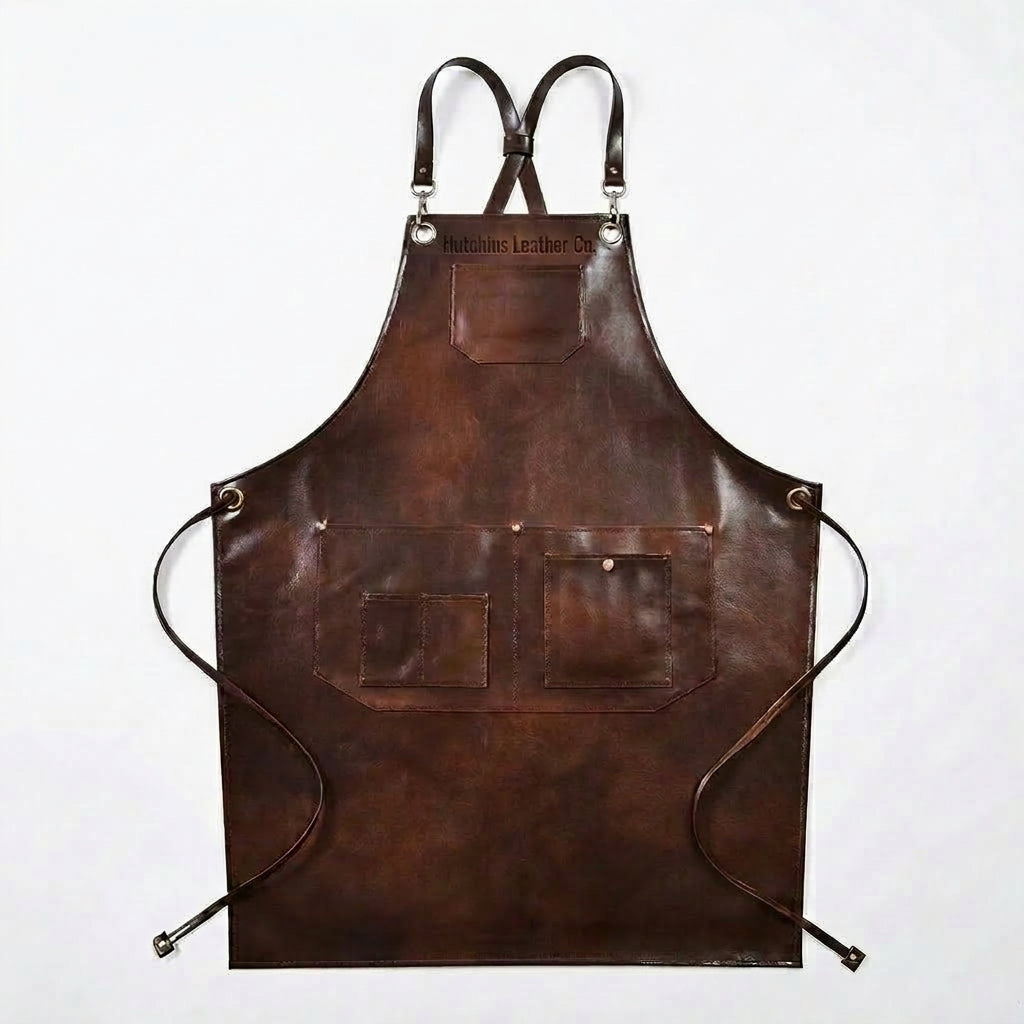
He Has Bought 3 Shop Aprons In 5 Years And Every One Split In The Same Place, 4 Tests Say Why
Each one gave way at the fold across the waist, in its second year. The test brings that failure forward to three minutes, and the apron that came through it ships at $89.

Three aprons in five years. Each one opened at the same place — the fold across the waist, where a man bends all day — and each time it read like bad luck rather than a pattern.
Then four aprons went on the same work table on a Tuesday morning in July: three ordered online the week before, the fourth off his own rack. All four are sold as leather. One of them would not split, and it was possible to see why in about three minutes.
So he ran the same four tests on all four, in the same order, on the same square inch of each front panel. A drop of water. Forty folds. A thumbnail. Eleven pounds of tools hung from the lower pocket.
Three of the four failed the first test in under three minutes. What follows is what each test showed, and why none of it appears in a product photograph.
Where He Learned To Read A Hide In Eight Seconds

He was eight years old the first time his father put a scrap of hide in his hand and told him to find the edge where the grain stopped. It is the trade's oldest test and it costs nothing: the top of a hide has a surface that grew there, and the bottom half — the split — does not.
Forty-seven years later he still checks a hide the same way, and it takes him about eight seconds. Most buyers never get the chance. A hide arrives already cut, already sealed, already photographed under a warm light, and the word on the tag is the same word for both halves.
“Leather is a legal word, not a grade,” he says. “You can take the bottom of a hide, spray a grain onto it, and print that word on the label. None of it is illegal. It is just not the thing people think they bought.”
So he stopped arguing about it and started testing instead. Four aprons, four tests, one table. No opinions and no brand names — only what each panel did when it was asked to behave like skin.
The First Test Takes One Drop Of Water And Three Minutes
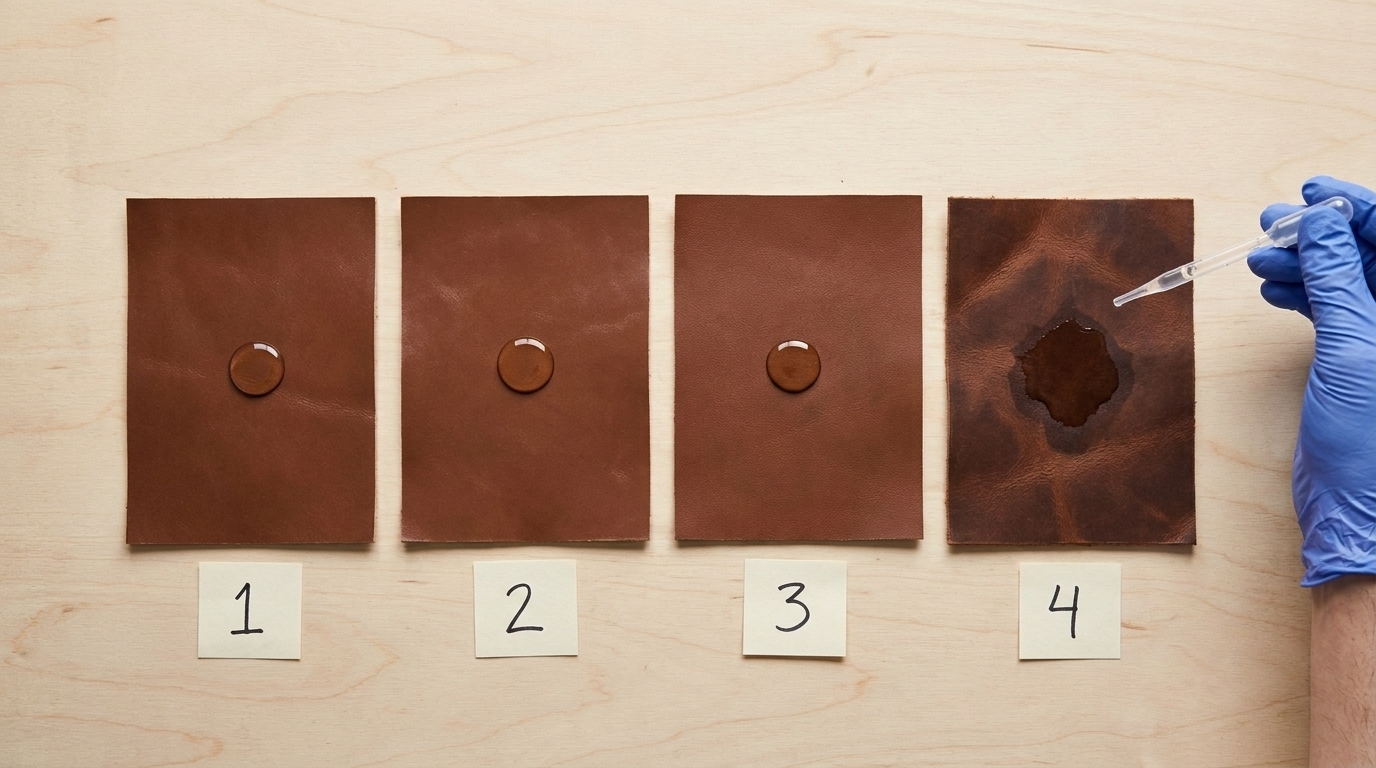
This is the test anyone can run at home, and it is the one that ended the morning early. One drop of tap water, placed flat on the front panel, left alone for three minutes.
Leather is skin, and skin takes water in. The drop darkens at the edges within about forty seconds, spreads slightly, then disappears, leaving a faint ring that fades as it dries. That is not damage. It is the material doing what it has done for four thousand years.
On three of the four aprons, the drop did nothing. It sat on the surface like water on a car hood, held its shape for the full three minutes, and rolled off when the panel was tilted. Nothing went in, because nothing could.
A surface that repels water that completely is not a grain. It is a finish — a pigmented film sprayed onto a split and embossed with a grain pattern while it cures. It photographs beautifully. It is also the reason that apron will look older in year two than the one that took the water.
The fourth panel darkened in thirty-one seconds and was dry and even again by lunch.
Under A Thumbnail, Three Of Them Had A Coat
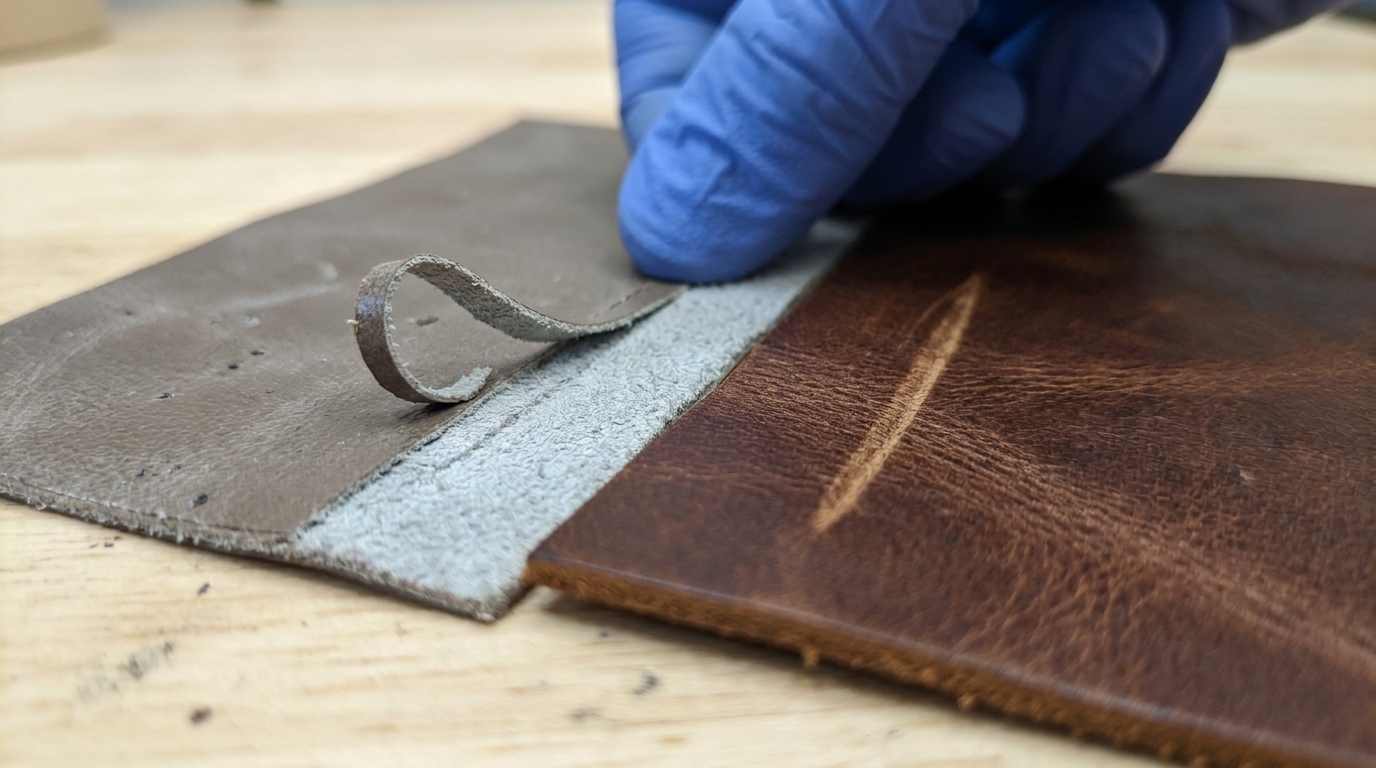
The second test is a thumbnail dragged once, firmly, across the panel at a forty-five degree angle. Every leather buyer does it without thinking about it.
Full-grain leather takes the mark and keeps it for a minute or two. The fibres compress, the line goes lighter, and a thumb rubbed over it warms the wax and puts it back. It is the same property that makes a scratch on a good apron disappear by the end of the week.
On the three coated panels the nail compressed nothing. It lifted. A thin curl of finish came up along the line, and underneath it the material was grey, dry and fuzzy — the raw split, buffed but never grained.
The third test was forty folds across the same crease. On the coated panels a pale line appeared between fold eleven and fold nineteen, and by fold forty it had opened into a hairline crack that would not close. That crack is where each of those three aprons will eventually fail — at the fold across the waist, exactly where a man bends all day.
On the fourth panel the crease darkened, held, and softened. Forty folds later it was a fold line, not a fault line.
"I ran the water test on the apron I had been wearing for two years, in front of my own crew, and it beaded. I paid a hundred and forty dollars for that thing. Nobody lied to me — I just did not know there was a test."
Eleven Pounds Overnight And Two Pockets Let Go By Morning

The last test had nothing to do with leather. Eleven pounds of tools — a block plane, two squares, a folding rule, a handful of drivers — went into the lower right pocket of each apron, and all four were hung on the wall overnight.
By morning, two of the four pockets had pulled away at the top corner. The stitching was intact. The material around it was not: the thread had migrated straight through the panel under load, because there was no rivet at the corner to stop it.
A rivet at each pocket corner costs a few cents and takes a few seconds. It is the most common thing removed from an apron to hit a price, and it is invisible in every photograph — because a photograph is taken with the pockets empty.
The weight matters somewhere else too, and that part ended up in a doctor's office.
Three of the four aprons hang their whole load from one narrow strap across the back of the neck. Loaded, that is eleven pounds pulling forward on the same two inches of skin, for eight hours, on a body already leaning over a table.
He woke with a numb right arm often enough that he finally had it looked at. Nothing was broken. What he was shown was simple enough that he has repeated it to every customer since: weight carried on one strap is carried by the neck, and weight carried on a crossed yoke is carried by both shoulders.
The fourth apron is the one with the crossed yoke. That was never a style decision.
$259 On A Shelf, $89 From The Man Who Cuts It
A wholesaler came to see him in the spring with a straightforward offer: $32 per apron, take the lot, no questions. Those aprons would have gone onto shelves at $259.
He said no on the spot — not for pride, for arithmetic. At $32 he would have had to change the leather to keep making them, and the moment he changed the leather he would be selling one of the three aprons that failed his own tests.
So he sells them himself. No wholesaler, no shelf, no chain keeping $227 of the price for putting the thing behind glass. The apron that passed all four tests goes out at $89, and $259 is what the same object costs once it has travelled through two middlemen.
That is the whole reason the price looks wrong. It is not a discount and nothing is being cleared out. It is the same apron with the retail layer taken off.
Same hide, same yoke, same riveted corners — simply not routed through anyone else's markup.
What Owners Write After The Second Winter

He has been sending these out for years, mostly to people who found him through somebody else's apron. The letters rarely mention leather at all. They mention the second winter, which is when the difference stops being an argument and becomes visible on the wall.
"Mine is six years old. The corner I catch on the table saw every single day has gone almost black and slightly shiny. My old one had a scuff in the same place that turned white, then grey, then flaked off. I did not understand what I was looking at until somebody explained the difference."
"I bought one for myself and one for the man who trained me. His is older than mine and it looks better. That is the part I still find strange — it is the only tool in my shop that is improving."
"I have owned eight aprons in thirty years. Two canvas, five sold as leather, one that actually was. The eighth is the only one I have never had to think about."
What stands out in those letters is not the praise. It is the timing. Nobody writes in the first month — in the first month, all four aprons on that table look the same.
They write in year two and in year six, which is exactly when the coat opens along the waist fold on the other three.
The reason is not a secret and it is not marketing. It is a short list of construction choices, and every one of them can be checked with your own hands the day the parcel arrives.
What Lets One Apron Pass All Four Tests
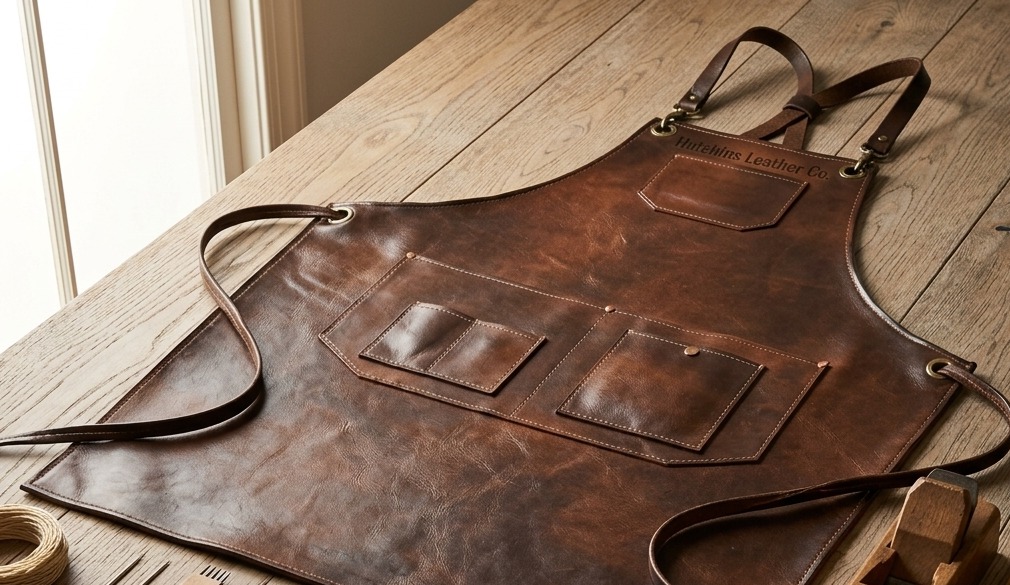
These are not claims. They are the four things the tests were measuring, and you can repeat every one of them yourself.
Full-grain front panel — the top layer of the hide, with the grain it grew, not a film sprayed onto a split. This is what takes a water drop in thirty-one seconds, and what turns a scratch into a shine instead of a scar.
Vegetable-tanned leather yoke, 4 to 5 ounces, paired with waxed 18-ounce canvas on the body panels — two materials each doing the job it is good at, instead of one pretending to do both.
Crossed back yoke — the load sits across both shoulders instead of hanging from the back of your neck. This is the change owners notice on the first evening, before they notice anything about the leather.
Solid rivets at all four pocket corners and at both strap anchors. Eleven pounds hung overnight is a low bar. It is also the bar that two of the four aprons on that table did not clear.
Two large lower pockets, a chest pocket sized for a folding rule and a pencil, and edges sealed so they do not fray where the apron rubs the table edge all day.
CHECK AVAILABILITYHow To Get The Apron That Passed

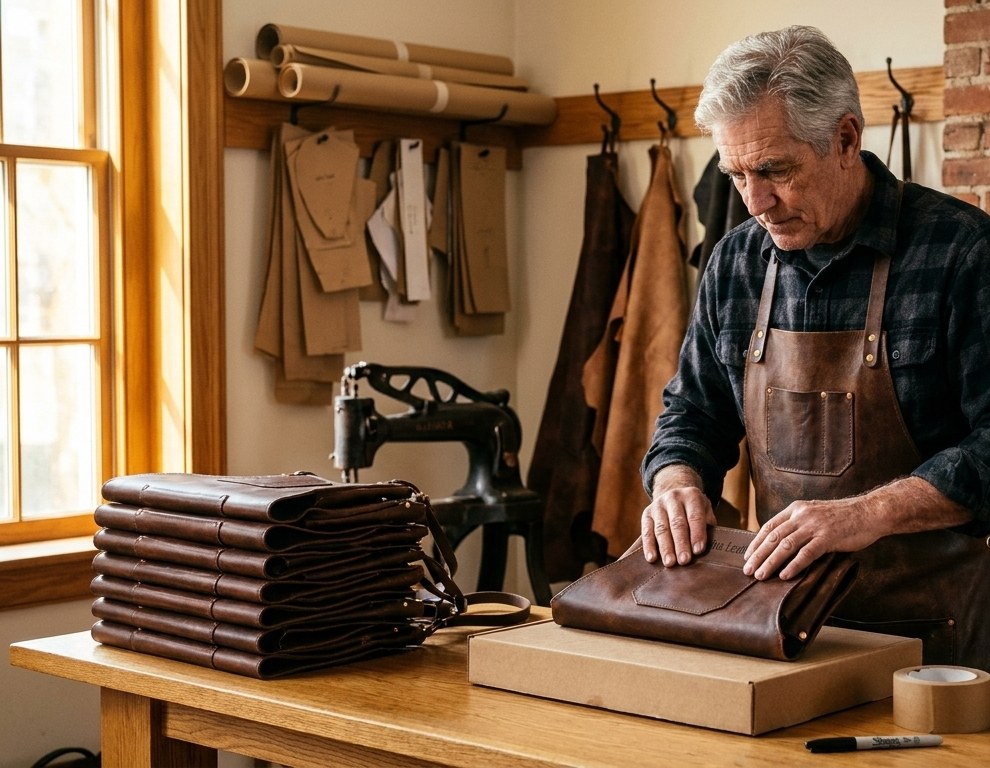
It ships from the same room it is cut in, in a plain box, usually within one business day. There is no waiting list and no queue.
This is not a clearance and it is not a seasonal event. It is the ordinary price of an apron sold by the man who cuts it, without the layer that turns $89 into $259.
Every order is checked and packed before it leaves, and the return window runs a full 30 days from delivery — including aprons that have already been worn in the shop.
What buyers report in the first weeks:
"It arrived stiffer than I expected. Two weeks in it has taken the shape of my chest and it does not shift around when I lean over the table."
"Heavier empty, lighter loaded. That sounds like nonsense until you wear it — the crossed yoke moves the weight off your neck and you stop noticing it is there."
If it does not do what the four tests say it does, it goes back inside 30 days and the money comes back with it.
For anyone who has already worn out one apron and would rather not do it twice, the four tests are the whole argument. Run them on whatever you own now, then run them on this one.
— 47 years cutting hides, Lancaster, Pennsylvania